5 Times Dairy-Free Substitutes Behave Completely Differently Than You Expect
Quick Answer: Dairy-free substitutes that fail most often do so because they lack a specific functional property of dairy (fat content for richness, casein for browning, or acidity reaction for leavening) rather than because the swap ratio was wrong — knowing which property each recipe depends on prevents most dairy-free baking and cooking failures.
Swapping in a dairy-free alternative usually works fine for flavor, but recipes fail in specific, predictable ways when the substitute is missing a functional property the original dairy ingredient was providing.

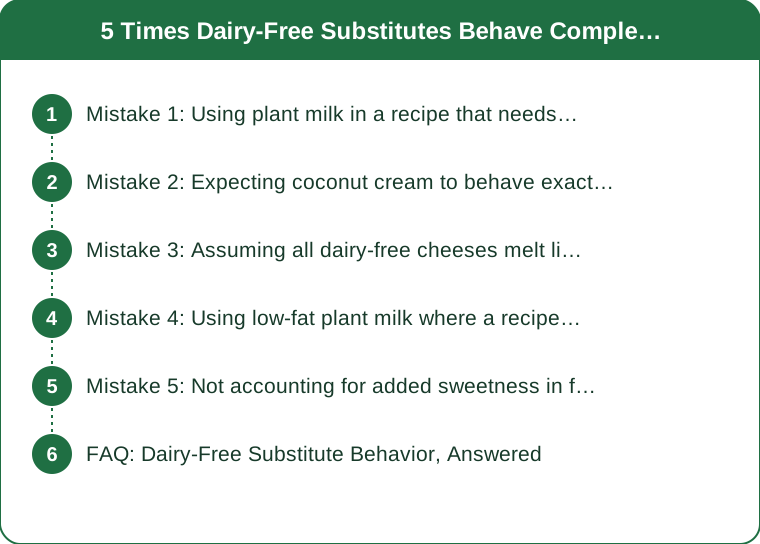
Mistake 1: Using plant milk in a recipe that needs buttermilk’s acidity
Buttermilk’s acidity reacts with baking soda to create rise in recipes like pancakes and quick breads — swapping in plain plant milk without adding acid (a splash of lemon juice or vinegar) removes that leavening reaction, resulting in denser, flatter baked goods even though the liquid volume is correct.
Mistake 2: Expecting coconut cream to behave exactly like heavy cream in savory dishes
Coconut cream whips and thickens similarly to heavy cream, but it carries a distinct coconut flavor that doesn’t disappear in savory applications the way dairy cream’s neutral flavor does. This works fine in dishes where coconut flavor is welcome, but can noticeably change the flavor profile of a savory sauce that wasn’t designed around it.
Mistake 3: Assuming all dairy-free cheeses melt like real cheese
Many dairy-free cheeses rely on starches and oils rather than casein protein to create texture, and casein specifically is what gives real cheese its stretchy, browning melt — most dairy-free cheeses melt into a softer, sometimes greasy texture rather than the stretchy pull of dairy cheese, which surprises people expecting an identical melt.

Mistake 4: Using low-fat plant milk where a recipe depends on dairy’s fat content
Recipes like custards or rich sauces depend on dairy’s fat content for body and mouthfeel, and swapping in a low-fat plant milk (like unsweetened almond milk) rather than a higher-fat option (like full-fat coconut milk or cashew cream) often results in a noticeably thinner, less rich final texture.
Mistake 5: Not accounting for added sweetness in flavored plant milks
Many plant milks, even ‘unsweetened’ varieties, carry subtle inherent sweetness or flavor notes from the base ingredient (oat, almond, soy) that can shift a savory recipe’s flavor balance in ways whole dairy milk’s neutral flavor wouldn’t. Checking for a genuinely neutral, unsweetened option matters more in savory cooking than in baking, where some sweetness is often welcome anyway.
FAQ: Dairy-Free Substitute Behavior, Answered
Is there a single best all-purpose dairy-free milk substitute?
No single option works best everywhere — oat milk tends to perform well in baking, while full-fat coconut milk performs better in rich sauces and custards.
Do dairy-free substitutes need different quantities, not just different types?
Sometimes — particularly with cheese, using slightly more dairy-free cheese than a recipe calls for in dairy cheese can help compensate for its different melt behavior.
Are dairy-free substitutes always healthier than dairy?
Not inherently — nutritional profiles vary widely between dairy-free products, so checking labels matters more than assuming dairy-free automatically means healthier.
TL;DR:
- Buttermilk’s acidity affects leavening — plain plant milk swaps need added acid
- Coconut cream brings its own flavor that shows up more in savory dishes
- Dairy-free cheese lacks casein, so it won’t melt and stretch the same way
- Fat content matters for richness — low-fat plant milk thins out rich recipes
Before your next dairy-free swap, think about what functional job the dairy ingredient was actually doing — that’s the detail that predicts whether the substitute will work.
Keep Reading
This article is for general informational purposes only and is not medical advice. Always consult a qualified health professional for guidance specific to you.