Hitting Your Protein Target Dairy-Free: Life After Whey
Quick Answer: Going dairy-free typically removes 30 to 50 grams of easy daily protein - the yogurt bowls, cottage cheese, cheese snacks, and whey shakes that high-protein eating quietly leans on. The replacements: eggs, fish, chicken, tofu and tempeh, edamame, lentils, and seitan as food anchors; soy, pea, or blended plant protein powders where a shake used to live. Plant proteins are slightly less potent gram for gram, so the working rule is simple - portions get a touch bigger, and breakfast needs an actual plan instead of a yogurt cup.
Nobody misses dairy protein until week one of dropping it. On paper, protein lives everywhere. In practice, the modern high-protein day is scaffolded on dairy at every weak point - the grab-and-go yogurt, the cottage cheese bowl, the post-gym whey - and pulling that scaffold out without a replacement plan is how dairy-free eaters end up chronically 40 grams short and wondering why they are hungry and their training feels flat.

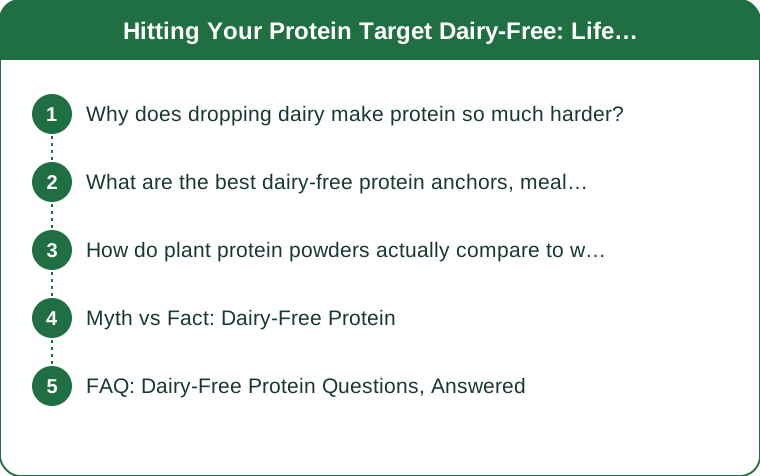
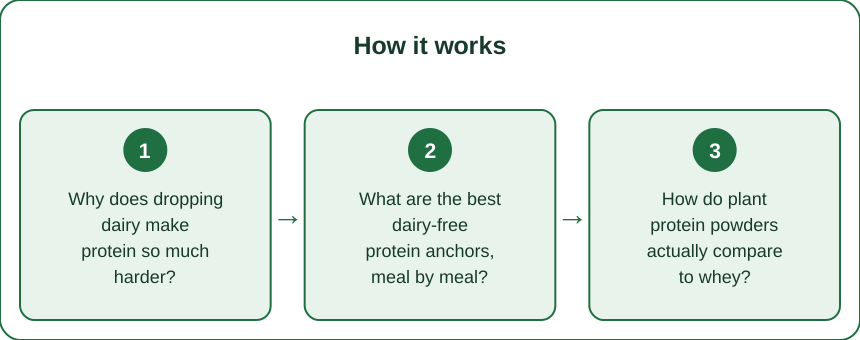
Why does dropping dairy make protein so much harder?
Because dairy was not just one protein source - it was the convenient one, at the hardest times of day.
Run the honest math on a typical high-protein day. A Greek yogurt at breakfast: around 15 to 18 grams. Cottage cheese with lunch or as a snack: about 25 per cup. A whey shake after training: 25 more. Cheese folded into whatever dinner was: another 5 to 10. That is 60-plus grams - often a third to half of the whole day’s target - gone with one dietary decision.
The loss concentrates at breakfast and snacks. Dinner survives dairy-free easily; chicken, fish, and beans never needed it. The damage lands where dairy was doing its real job - the moments requiring zero cooking. Yogurt asked you to open a lid. Its dairy-free replacements mostly ask you to cook, and at 7am, ask-to-cook frequently loses. This is why the dairy-free protein gap is really a convenience gap wearing a nutrition costume.
Quality shifts a little, too. Whey and casein are complete proteins, rich in leucine - the amino acid that most directly triggers muscle protein synthesis - and they digest efficiently. Most single plant proteins are lower in one amino acid or another and a bit less digestible, which is not the crisis the internet makes of it, but it does mean gram-for-gram equivalence is slightly generous toward plants.
And the default swaps are decoys. The instinctive replacements - almond milk, coconut yogurt, most oat products - are dairy-free but essentially protein-free: a typical almond milk carries about 1 gram per cup against dairy milk’s 8. Swapping dairy for its lookalikes keeps the ritual and silently deletes the protein. The fix is swapping for actual protein sources, which look different from what they replace.
What are the best dairy-free protein anchors, meal by meal?
The day is won at breakfast and snacks - the slots dairy used to own. The working roster, with honest numbers:
Breakfast, the priority battle:
- Eggs - about 6 grams each; three scrambled with a handful of edamame or a side of turkey sausage clears 25.
- Tofu scramble - firm tofu crumbles like soft eggs and takes any seasoning; roughly 20 grams per half block, and it reheats better than eggs for weekday batches.
- Protein oats - oats cooked in soy milk (7 to 8 grams per cup, the only mainstream plant milk that competes with dairy) plus a scoop of plant protein stirred in after cooking: 30-plus grams in a familiar bowl.
- Soy or pea-blend yogurt alternatives - the one aisle exception: unlike almond and coconut versions, soy-based yogurts carry real protein, often 8 to 12 grams per serving. Read the label; the range across brands is wild.
Lunch and dinner anchors: chicken, turkey, fish, and lean beef obviously survive the transition untouched - a palm-sized portion lands 25 to 35 grams. The plant side: tempeh (about 30 grams per cup, and it crisps beautifully), tofu (20 per half block), lentils and beans (15 to 18 per cooked cup, arriving with fiber), edamame (17 per cup, the most underrated snack in this whole conversation), and seitan (about 25 per serving - the highest plant number going, though it is pure wheat gluten, so celiac and gluten-free households skip it).
Snacks, where dairy hurt most: roasted chickpeas or edamame, jerky, hummus with anything, a handful of nuts (modest protein, good bridge), hard-boiled eggs from a weekly batch, or simply a half-portion shake. The strategic move is accepting that dairy-free snacking requires ten minutes of Sunday prep - the boiled eggs and roasted chickpeas do not exist unless someone makes them exist.

How do plant protein powders actually compare to whey?
Closer than the gym-bro consensus admits, with two honest asterisks.
The performance question has been studied properly. Head-to-head trials comparing plant proteins - especially soy and pea - against whey on strength and muscle growth mostly find similar outcomes when total daily protein is equal and doses are adequate. The muscle does not check the ingredient list; it checks the amino acids delivered. Blends of rice and pea protein were engineered specifically to mimic whey’s amino profile, and they get genuinely close.
Asterisk one: leucine density. Whey is exceptionally leucine-rich; most plant powders carry less per gram. The practical translation is not plants fail - it is take a slightly bigger dose. Where 25 grams of whey reliably clears the muscle-building trigger threshold, aim for 30 to 40 grams of a plant blend to land the same signal. One extra half-scoop, problem closed.
Asterisk two: texture and taste are a real adoption barrier. Pea protein in water is grittier and earthier than whey, and pretending otherwise is how people quit. The fixes that work: blend with frozen banana and soy milk rather than shaking with water, choose blends over single-source powders (rice smooths pea), chocolate flavors hide earthiness better than vanilla, and let the mixed shake sit two minutes - hydrated plant protein drinks noticeably smoother.
Choosing between the main options: soy isolate is the most whey-like nutritionally and usually cheapest; pea-rice blends are the crowd-pleaser compromise; hemp brings fiber and omega-3s but modest protein density - more a food than a shake base. Whatever the pick, look for third-party testing marks, since powders are supplements and supplement quality control is famously uneven.
And keep the powder in its lane. A shake is a tool for the gap the day actually has - typically post-training or the rushed breakfast - not a food-replacement lifestyle. If the powder is showing up three times a day, the food plan upstream needs work before the supplement plan does.
Myth vs Fact: Dairy-Free Protein
Myth: Plant protein is incomplete, so it cannot build muscle. Fact: The incomplete framing is outdated in practice - varied plant eating across a day covers the amino acid spectrum, blends are formulated to be complete, and soy is complete on its own. Trials show comparable muscle outcomes when total protein and doses are matched. The muscle is not loyal to cows.
Myth: You cannot hit high protein targets without dairy or powders at all. Fact: Eggs, fish, poultry, tofu, tempeh, lentils, and edamame can carry an entire high-protein day - people did it for centuries. Powders are a convenience solving the schedule, not a nutritional necessity solving the biology.
Myth: Lactose-free products are dairy-free. Fact: Lactose-free milk and yogurt are dairy with the lactose enzyme-treated - the milk proteins, casein and whey, are fully present. For lactose intolerance they are a solution; for a milk allergy or a true dairy-free diet they are not. The two labels get confused constantly, sometimes by store shelving itself.
Myth: Pea protein bloats everyone. Fact: Some people experience gas with legume-based powders, often dose-dependent and often temporary as the gut adjusts. Starting with half servings, choosing isolates over concentrates, and blends over pure pea resolves most cases. Everyone is doing a lot of work in that myth.
Myth: Soy is off-limits for hormonal reasons. Fact: The large body of human research does not support meaningful hormonal disruption from normal food amounts of soy - a few servings a day sits comfortably inside the evidence. Individual medical situations vary, which is a conversation for your clinician, not a reason for blanket avoidance. General information, not medical advice.
FAQ: Dairy-Free Protein Questions, Answered
How much protein do I actually need?
Common evidence-based ranges run from about 0.7 to 1 gram per pound of body weight daily for active people pursuing muscle or strength - less for general health. The dairy-free part changes the sourcing, not the target. General information; individual needs vary, especially with medical conditions.
What is the best dairy-free breakfast protein?
Eggs and tofu scramble tie for the whole-food crown; protein oats made with soy milk plus a stirred-in scoop win the speed division at 30-plus grams. The real answer is whichever one you will repeat on a Tuesday - breakfast protein is a consistency contest, not a nutrition contest.
Does oat milk have protein?
Barely - typically 1 to 3 grams per cup, against dairy milk’s 8 and soy milk’s 7 to 8. Oat milk is a texture choice, not a protein source. If plant milk is carrying protein duty anywhere in your day, that duty belongs to soy.
Is a vegan protein powder necessary if I still eat meat and eggs?
Often no - meat, fish, and eggs can close the whey gap entirely if your schedule lets you cook. The powder earns its place at the moments cooking loses: post-gym, travel mornings, the 3pm cliff. Buy it for your calendar, not your ideology.
TL;DR:
- Dropping dairy removes 30 to 50 easy grams - mostly from breakfast and snacks, where convenience mattered.
- Anchor replacements: eggs, tofu and tempeh, fish and poultry, lentils, edamame, seitan - and soy milk over almond, always, for protein.
- Plant powders match whey in outcomes when dosed slightly higher; blends beat single sources on texture.
- Lactose-free is not dairy-free - the proteins are still there.
- Sunday prep of boiled eggs and roasted chickpeas is the entire snack strategy.
Whey was never magic - it was just frictionless. Rebuild the frictionless moments with different ingredients, and the target that felt impossible in week one becomes arithmetic again by week four.
Keep Reading
This article is for general informational purposes only and is not medical advice. Always consult a qualified health professional for guidance specific to you.