Going Dairy Free Without Losing Fermented Foods — What Actually Works
Quick Answer: Cutting dairy usually removes yogurt and kefir, which for many people were their main source of live cultures. The best replacements are not dairy-free yogurts — most are low in both protein and live bacteria — but fermented vegetables, water kefir, and tempeh. If you want a dairy-free yogurt, look for one listing specific bacterial strains and at least 5g of protein per serving.
Most dairy-free guides handle calcium, protein and vitamin D. Almost none mention that you have also just deleted the fermented food category from your diet.
For people who ate yogurt daily, that is a real change — and the obvious substitute on the shelf is usually the weakest option available.

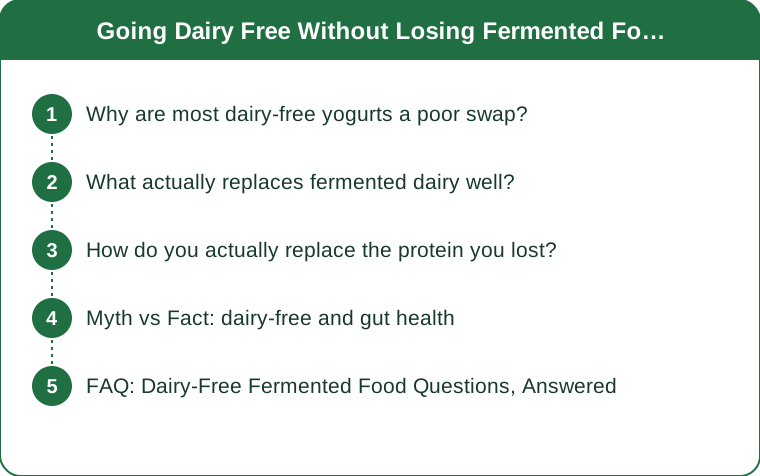
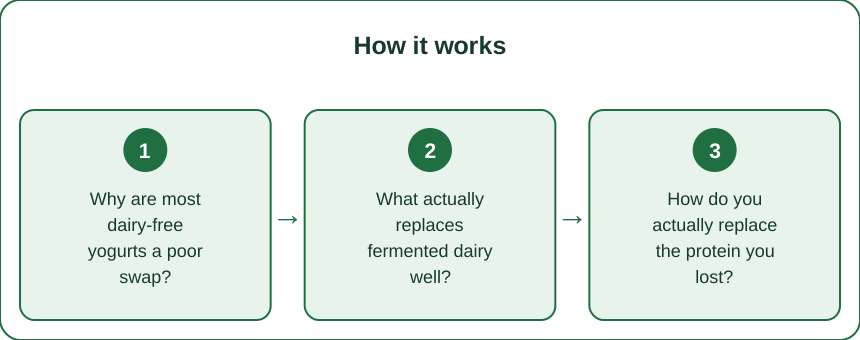
Why are most dairy-free yogurts a poor swap?
Two reasons, and both are visible on the label if you know where to look.
Protein. A cup of Greek yogurt has around 17 to 20 grams of protein. A typical coconut-based yogurt has 1 to 2 grams. Almond-based versions sit around 3 to 5. Oat-based are often under 2. If yogurt was carrying a meaningful part of your daily protein, swapping to coconut yogurt is a quiet loss of 15 grams a day that shows up later as being hungry at 3pm and wondering why.
Soy yogurt is the exception, typically landing at 6 to 9 grams per serving, which is why it remains the most nutritionally sensible dairy-free yogurt despite being less fashionable than the coconut versions.
Live cultures. Not all dairy-free yogurts are actually fermented. Some are thickened plant bases with flavouring, cultured briefly or not at all, and heat-treated afterwards — which kills whatever bacteria were there. The tell: look for the phrase live and active cultures and, better, named strains such as L. acidophilus or B. lactis. A product that just says probiotic without naming anything is telling you as little as legally possible.
Also watch added sugar. Flavoured plant yogurts frequently run 12 to 18 grams per serving, because plant bases are bland and sugar is the cheapest fix.
What actually replaces fermented dairy well?
Four options, in descending order of how well they cover what you lost.
Fermented vegetables — sauerkraut, kimchi, fermented pickles. These are the strongest replacement for live cultures and the cheapest. The critical detail: they must be refrigerated and unpasteurised. Shelf-stable sauerkraut in a can has been heat-treated and contains no live bacteria. A tablespoon or two daily is a reasonable dose. Kimchi has the added advantage of being genuinely good food rather than a supplement you tolerate.
Water kefir. This is the closest functional analogue to milk kefir — a fermented drink with a broad range of bacteria and yeasts, made with sugar water and kefir grains rather than milk. It is tart, lightly fizzy, and easy to make at home for almost nothing.
Tempeh. Fermented soybeans, high in protein at around 19 grams per 100g, and a genuinely useful dinner ingredient rather than a snack. The fermentation also makes soy’s minerals more available.
Miso and natto. Miso is fermented and useful, with the caveat that boiling it kills the cultures — stir it in off the heat. Natto is the most potent option nutritionally and the hardest sell texturally.
What does not count: sourdough bread (baked, so no live cultures survive), most kombucha on shelves (variable and often heavily pasteurised), and anything labelled probiotic that is not refrigerated.

How do you actually replace the protein you lost?
This is the part that quietly derails people, because the fermented food question and the protein question get treated separately when they were solved by the same food.
If your daily Greek yogurt was providing 18 grams, you need that back from somewhere. Practical swaps at roughly equivalent protein:
- Soy yogurt with added protein — around 8 to 10g, so roughly half the job.
- A scoop of pea or soy protein isolate stirred into a plant yogurt — adds 15 to 20g, and turns a weak product into a functional one.
- Silken tofu blended into a smoothie — about 8g per 100g, neutral tasting, and a good texture solution.
- Tempeh at dinner — 19g per 100g and covers the fermented food box at the same time.
The combination most people land on: soy or almond yogurt plus a protein scoop for breakfast, kimchi or sauerkraut with lunch, tempeh once or twice a week at dinner. That covers protein, live cultures and variety without requiring anyone to enjoy natto.
A practical target worth knowing: most adults do better at 1.2 to 1.6g of protein per kg of body weight if they train regularly, and dairy is a dense, convenient source that is genuinely hard to replace by accident. It has to be replaced on purpose.
Myth vs Fact: dairy-free and gut health
Myth: Cutting dairy improves gut health. Fact: For people with lactose intolerance or a dairy allergy, absolutely. For everyone else the evidence points the other way — fermented dairy is one of the better-supported foods for gut microbial diversity. Cutting it without replacing the fermented food category is a net loss for most people.
Myth: A probiotic supplement covers it. Fact: Supplements deliver a narrow set of strains in high doses. Fermented foods deliver a wide range in lower doses, plus fibre and the fermentation byproducts. They are not interchangeable, and the food version is cheaper. Supplements have their uses — after antibiotics, for specific conditions — but they are not a fermented food replacement.
Myth: Kombucha is a great probiotic source. Fact: Highly variable. Commercial kombucha is often pasteurised or has such low live counts that it functions mainly as a low-sugar soft drink. It is not harmful and some people love it, but do not count on it.
Myth: All dairy-free yogurts have live cultures. Fact: Many do not, and the ones that do vary enormously. Read for named strains and the words live and active.
FAQ: Dairy-Free Fermented Food Questions, Answered
How much fermented food do I actually need?
There is no established requirement, but research on fermented food intake has generally used something in the range of one to two servings daily — a small bowl of yogurt, a couple of tablespoons of kimchi, a glass of water kefir. Consistency matters more than quantity.
Will fermented vegetables upset my stomach?
They can at first, particularly if your diet has been low in fibre and fermented foods. Start with one teaspoon and build over two weeks rather than starting with a full serving. Bloating in the first few days is common and usually settles.
Is coconut yogurt useless then?
Not useless — it is a fine occasional food and some brands do have genuine live cultures. It is just a poor nutritional substitute for dairy yogurt, and it should not be your only fermented food or a protein source.
Can I make dairy-free yogurt at home?
Yes, and it solves the culture question completely. Soy milk works best because the protein sets properly; coconut milk needs a thickener. A yogurt maker or an oven with the light on is enough.
Does dairy-free mean I need a calcium supplement now?
Not necessarily, but it does mean calcium needs attention. Fortified plant milks, tofu set with calcium sulfate, and leafy greens can cover it — it just does not happen by accident the way it did with dairy.
This is general information, not medical advice. If you are cutting dairy because of a suspected allergy or intolerance, get it properly assessed rather than self-diagnosing.
TL;DR:
- Cutting dairy usually deletes your main fermented food and a large chunk of daily protein at the same time.
- Most plant yogurts are weak on both — soy is the best of them; check for named live strains and 5g+ protein.
- The strongest replacements are refrigerated unpasteurised fermented vegetables, water kefir and tempeh.
- Replace the protein deliberately; it will not happen by itself.
Going dairy free works perfectly well nutritionally, but only if you replace what dairy was actually doing rather than what the shelf suggests it was doing. Fermented vegetables and tempeh are cheaper, more interesting and more effective than the yogurt aisle.
Keep Reading
This article is for general informational purposes only and is not medical advice. Always consult a qualified health professional for guidance specific to you.