Dairy-Free Butter Substitutes for Baking: The Exact Ratios That Actually Work
Quick Answer: Vegan butter sticks swap 1:1 for dairy butter in most recipes with minimal adjustment. Coconut oil needs a slightly reduced amount (about 7/8 cup per 1 cup butter) since it’s pure fat with no water content, and works best in recipes that don’t rely on butter’s creaming properties.
You’ve had dairy-free baked goods turn out greasy, dense, or oddly textured and assumed the recipe itself was the problem. Usually it’s the substitution ratio, not the recipe.

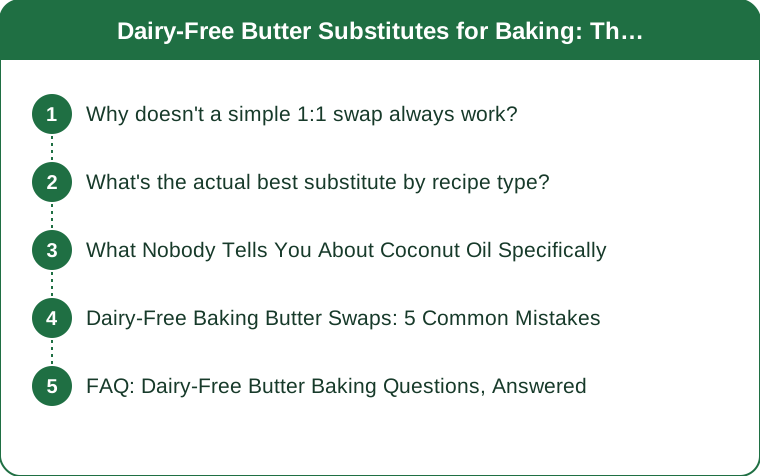
Why doesn’t a simple 1:1 swap always work?
Dairy butter is roughly 80% fat and 15-20% water, and that water content matters for gluten development and texture in baked goods. Pure-fat substitutes like coconut oil or shortening don’t have that water, so a straight 1:1 swap can produce a denser, sometimes greasier result unless you account for the missing liquid.
What’s the actual best substitute by recipe type?
Vegan butter sticks (formulated to mimic dairy butter’s fat/water ratio): the most reliable 1:1 swap for cookies, cakes, and anything relying on creaming butter with sugar. Coconut oil: works well in melted-butter recipes (some brownies, quick breads) at roughly 7/8 cup per 1 cup butter; less ideal for creamed recipes since it doesn’t hold air the same way. Applesauce or mashed banana (partial swap, not full): can replace half the fat in quick breads and muffins for a lower-fat result, but changes texture and shouldn’t fully replace butter in cookies.

What Nobody Tells You About Coconut Oil Specifically
Coconut oil is solid at cool room temperature but melts around 76°F, which means recipes need to account for kitchen temperature — a “creamed” coconut oil and sugar mixture behaves very differently in a warm kitchen than a cool one, sometimes requiring a quick fridge chill before proceeding with a recipe.
Dairy-Free Baking Butter Swaps: 5 Common Mistakes
1. Using melted coconut oil where a recipe calls for creamed butter — this skips the air-incorporation step that gives cookies their structure.
2. Not reducing liquid elsewhere in the recipe when using a wetter substitute like applesauce.
3. Assuming all vegan butters perform identically — some brands have more water content than others; check the fat content on the label if a recipe isn’t turning out right.
4. Skipping a full swap test on a special-occasion bake — test a smaller batch first for anything you can’t afford to have fail.
5. Forgetting salt adjustment — some butter substitutes are unsalted where dairy butter recipes assumed salted; taste and adjust.
FAQ: Dairy-Free Butter Baking Questions, Answered
Does dairy-free butter brown the same way as dairy butter for browned-butter recipes?
Not quite — vegan butter alternatives don’t develop the same nutty milk-solid flavor when browned, since that reaction comes from dairy proteins specifically.
Can I use olive oil instead of butter in baking?
In some recipes yes (especially cakes), but its distinct flavor and liquid-at-room-temperature state make it a poorer match for cookies or anything needing a solid-fat structure.
Is margarine the same as vegan butter for baking purposes?
Many margarines are dairy-free and work similarly, but check the label — some contain whey or other dairy derivatives despite being marketed as butter alternatives.
TL;DR:
- Vegan butter sticks are the most reliable 1:1 swap across most recipe types
- Coconut oil works best in melted-butter recipes, use about 7/8 cup per 1 cup butter
- Water content is the hidden variable — that’s why a straight swap sometimes fails
- Test a smaller batch first before using a new substitute for anything high-stakes
Keep Reading
This article is for general informational purposes only and is not medical advice. Always consult a qualified health professional for guidance specific to you.